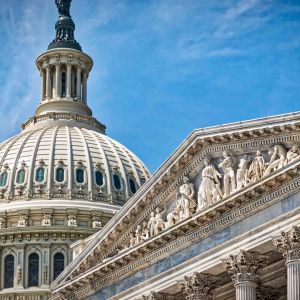
House Republicans have included an anti-CBDC provision in the National Defense Authorization Act for the next financial year. The measure seeks to ban the Federal Reserve from testing, developing, or implementing any central bank digital currencies. According to the amendment in bill H.R. 3838, CBDCs that are open, permissionless, and private will be exempted from the provision. Dollar-denominated currencies that maintain the privacy protections of United States coins and physical currency will also be excluded from the amendment. Anti-CBDC provision codifies with Trump’s order against CBDCs Central Bank Digital Currency (CBDC) would give unelected bureaucrats in our federal government absolute control over YOUR MONEY. This is wrong & this is a dangerous threat to freedom. Yesterday, the House voted 219-210 to BLOCK this globalist tyranny from infiltrating America. pic.twitter.com/JSgU2OhWVB — Congressman Byron Donalds (@RepDonaldsPress) July 18, 2025 The defense bill is seen as national security legislation that must pass the Senate since it determines how the military will be funded and how it will spend its budget. Republicans caused a stalemate of over nine hours in the House after refusing to move the three crypto bills forward unless a CBDC provision was guaranteed to pass. As previously reported by Cryptopolitan, those bills include the Digital Asset Market Clarity (CLARITY) Act, the Guiding and Establishing National Innovation for U.S. Stablecoins (GENIUS) Act, and the Acti-CBDC Surveillance State Act. House Majority Leader Steve Scalise assured the House that the CBDC measure would be included in the defense spending legislation. “Attaching our Anti-CBDC Surveillance State Act to the NDAA will ensure unelected bureaucrats are never allowed to trade Americans’ financial privacy for a CCP-style surveillance tool.” – Tom Emmer , Majority Whip of the U.S. House of Representatives. Emmer said the legislation aims to prevent unelected bureaucrats from creating a financial surveillance tool that could disrupt the lives of U.S. citizens. He also acknowledged that the bill codifies U.S. President Donald Trump’s Executive Order to prevent the development of a CBDC. The White House championed the legislation, saying that it protects the financial privacy and constitutional liberties of every American. The report identifies the Anti-CBDC State Act as a testament that the U.S.doesn’t allow political manipulation and government surveillance in its financial systems. Nanak Nihal Khalsa, co-founder of Holonym, referred to CBDCs as programmable money controlled by the state. He believes that the U.S.’s stance on CBDCs opens up space to build alternatives that are open, permissionless, and actually preserve privacy. Emmer makes an effort to introduce Anti-CBDC legislation The U.S. official had tried to introduce a CBDC Anti-Surveillance State Act in the last Congress in 2023. The bill failed to pass through to the Senate, but he reintroduced it, targeting the Fed’s digital currency efforts. Emmer’s similar flagship legislation passed Congress in July 2025 and is awaiting approval from the Senate. Senator Ted Cruz also introduced the Anti-CBDC Surveillance State Act in March in an attempt to block the Fed from issuing CBDCs. Senator Kevin Cramer argued that a dollar-backed digital currency has the potential for financial monitoring and surveillance and could turn the central bank into a retail bank. Senator Thom Tillis also reiterated Cramer’s remarks, adding that the bill would ensure Americans’ financial privacy. Emmer’s bill comes at a time when 135 countries are already exploring digital versions of their currency, with more than half in advanced stages of development.. According to the Atlantic Council, only 35 countries were experimenting with CBDCs in 2020, showing the growing interest in currency-backed digital assets for countries. Despite the House passing the CBDC Anti-Surveillance State Act, there has been a surge in opposition from critics, citing government overreach, surveillance, and disruption to the banking industry. The American Bankers Association (ABA) believes the legislation would fundamentally change the relationship between U.S. citizens and the Fed. The firm also argued that the bill could disrupt credit extension in banks, worsen economic and liquidity crises, and impede the transmission of sound monetary policy. ABA’s president and CEO, Rob Nichols, urged the Senate to pass the companion anti-CBDC bill introduced by Cruz for a safer economy. KEY Difference Wire helps crypto brands break through and dominate headlines fast