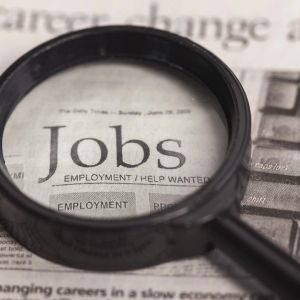
div]:bg-bg-000/50 [&_pre>div]:border-0.5 [&_pre>div]:border-border-400 [&_.ignore-pre-bg>div]:bg-transparent [&_.standard-markdown_:is(p,blockquote,h1,h2,h3,h4,h5,h6)]:pl-2 [&_.standard-markdown_:is(p,blockquote,ul,ol,h1,h2,h3,h4,h5,h6)]:pr-8 [&_.progressive-markdown_:is(p,blockquote,h1,h2,h3,h4,h5,h6)]:pl-2 [&_.progressive-markdown_:is(p,blockquote,ul,ol,h1,h2,h3,h4,h5,h6)]:pr-8"> _*]:min-w-0 standard-markdown"> There’s a lot of worry going around office buildings these days. Workers with college degrees are looking at a job market that’s gotten way less friendly than it was just a few years ago. Tuesday’s jobs report didn’t bring good news. The nation’s unemployment rate went up to 4.6%. Industries full of desk workers, tech, finance, that sort of thing, have been cutting positions in October and November. Labor Department numbers show companies that usually hire white-collar employees have been pulling back on hiring this year. More people with college degrees are finding themselves out of work. All this job market worry is making people anxious about the economy in general. The University of Michigan keeps track of how consumers feel about economic conditions, and right now those numbers are sitting near record lows . After almost five years of inflation chipping away at paychecks, lots of Americans are having a hard time financially. College-educated workers used to feel pretty safe from economic problems. Not anymore. Things have changed fast. Just a few years back, these same people were getting promotions and raises pretty regularly. Now they’re just trying to hang onto what they have, scared by all the news about layoffs, artificial intelligence taking over, and how rough it is out there for people looking for work. Fear of job loss hits record levels New numbers from the Federal Reserve Bank of New York, gathered in November, show something pretty striking. Workers with bachelor’s degrees or more now think there’s a 15% chance they’ll lose their jobs in the next year. Three years ago, that number was 11%. What’s really wild is that this educated group now thinks losing their job is more likely than people with less education do. That’s completely backwards from how things used to be. And they’re not feeling good about finding new work either. These college-educated workers figure they’ve only got about a 47% shot at landing a job within three months if they got laid off today. Three years ago, they would’ve said 60%. The government doesn’t really have a solid definition for white-collar workers, but basically it means office employees with higher education, bachelor’s degrees or at least some college. By some measures, this group is still doing okay. For workers 25 and older with bachelor’s degrees or higher, unemployment is at 2.9%. That’s relatively low, though it’s up from 2.5% a year earlier. People with college degrees still make a lot more money than those without them. But a lot of folks are starting to feel like something big is shifting. Right after the pandemic, companies were scrambling to hire office workers to deal with all the extra demand. Lately though, big companies including Amazon , United Parcel Service, and Target have been announcing white-collar job cuts. Some of them hired too many people and are fixing that mistake now. Others have hit pause on hiring while they figure out new White House tariff policies and budget cuts. AI threatens to replace office workers Company leaders are putting out warnings about artificial intelligence making the situation even worse . Earlier this year, Ford Motor’s CEO Jim Farley said the technology will “replace literally half of all white-collar workers in the U.S.” Data from Indeed shows job postings in some white-collar areas are way below where they were before the pandemic. Software development jobs in mid-December were only at 68% of their February 2020 level. Marketing roles were at 81% of pre-pandemic levels. Healthcare postings have held up much better, mostly because it’s a lot harder to replace those workers with AI. Federal workers also face uncertainty Government workers, who’ve traditionally had job security and good benefits, are dealing with a new reality too. Tuesday’s report showed federal employment dropped by 6,000 jobs in November. That came after a huge loss of 162,000 federal jobs in October, when workers who took a deferred-resignation deal came off the payroll. A lot of those people are scrambling for work now. Private-sector workers who got laid off back in spring or summer are burning through whatever severance they got. Even secure government jobs feel shaky. Priscilla Kloewer, an engineer who works for the federal government in Rhode Island, would’ve put her chances of losing her job at maybe 2% before the recent government shutdown. She didn’t get furloughed during the shutdown, but now she figures the risk is somewhere around 10% or less. Kloewer and her husband have a toddler, and they’re holding off on buying new appliances until Congress passes a longer funding bill. They’re watching prices go up for child care, groceries, and insurance. “I’m in a better position than people I know who are not white-collar workers,” Kloewer told Wall Street Journal. “It still feels precarious.” If you're reading this, you’re already ahead. Stay there with our newsletter .