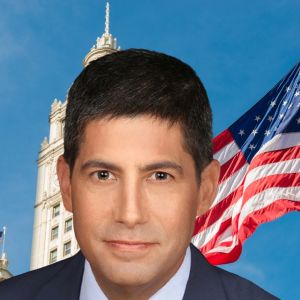
Donald Trump told reporters he would name the new Federal Reserve chair on Friday morning, but the thing is, he already has. “It’s going to be somebody that lot of people think could have been there a few years ago,” he said. That somebody is Kevin Warsh. None of the other nominees (Rick Rieder, Chris Waller, and Kevin Hassett) fit that description, because Trump considered Kevin eight years ago before picking Jerome Powell. For those of us obsessed with Wall Street, Kevin is a name that has been very well-known for at least 2.5 decades, especially after the 2008-09 financial crash when he worked behind closed doors trying to keep markets stable. Kevin’s path from Wall Street to the Fed’s inner circle Before the Fed, Kevin worked at Morgan Stanley from 1995 to 2002, rising to executive director in the firm’s mergers and acquisitions unit.Then he made the jump to the White House. From 2002 to 2006, he was Special Assistant to the President for Economic Policy and Executive Secretary of the National Economic Council. Kevin focused on domestic finance, banking rules, and consumer protection. He was also the main bridge between the White House and independent financial regulators. By January 2006, President George W. Bush nominated Kevin and Randall Kroszner to fill two open seats on the Federal Reserve Board. At just 35, Kevin became the youngest person ever nominated to the Fed, which somehow triggered criticism. Preston Martin, a former Fed vice chair, said it was “not a good idea” and that he’d vote no if he could. Bernanke later wrote, “His youth generated some criticism… but Kevin’s political and markets savvy and many contacts on Wall Street would prove to be invaluable.” During his confirmation hearing in February 2006, Kevin leaned on his market background. “I hope that my prior experience on Wall Street, particularly my nearly 7 years at Morgan Stanley, would prove beneficial to the deliberations and communications of the Federal Reserve,” he said. By March 2006, he attended his first Federal Open Market Committee (FOMC) meeting. Warsh warned of liquidity risks and was early critic of long-term stimulus Less than a year before Bear Stearns collapsed, Kevin spoke about market liquidity. In March 2007, he told the FOMC:- “The benefits of greater liquidity are substantial… But markets can become far less liquid due to increases in investor risk aversion and uncertainty. While policymakers and market participants know with certainty that these episodes will occur, they must be humble in their ability to predict the timing, scope, and duration.” As 2009 came, unemployment hit 9.5%. The Fed was still trying to help the economy recover. But Kevin said it might be time to stop. “If policymakers insist on waiting until the level of real activity has plainly and substantially returned to normal… they will almost certainly have waited too long,” he warned. Kevin pointed to high bank reserves and excess liquidity. “There is a risk… that the unusually high level of reserves… could fuel an unanticipated, excessive surge in lending.” That surge never came. Tim Duy, an economics professor, fired back. He said the Fed seemed “more willing to use unconventional monetary policy to support Wall Street than Main Street.” Still, Kevin kept raising doubts about the Fed’s approach. In November 2010, the Fed planned to push down long-term interest rates in a second round of quantitative easing (QE2). Unemployment was near 10%, but Kevin was not on board. He only agreed to vote yes “out of respect” for Bernanke. “If I were in your chair, I would not be leading the Committee in this direction,” he said. “And frankly, if I were in the chair of most people around this room, I would dissent.” He continued, “I think we are removing much of the burden from those that could actually help reach these objectives… and we are putting that onus strangely on ourselves rather than letting it rest where it should lie.” Kevin didn’t want monetary policy to cover for weak action from Congress. It was rare for a Fed governor to suggest holding back support to push other parts of government to do their job. Exit from the Fed and what comes next for monetary policy Ben Bernanke, in his memoir, wrote about the QE2 debate. He said, “Kevin Warsh had substantial reservations… Now that financial markets were functioning more normally, he believed that monetary policy was reaching its limits… and that it was time for others in Washington to take on some of the policy burden.” Bernanke said Kevin voted in favor “as he had promised,” but soon after, he gave a speech in New York and published an op-ed in The Wall Street Journal. In it, Kevin said the Fed couldn’t fix everything alone and called for tax and regulatory reforms to grow the economy. Bernanke agreed that infrastructure spending and other government actions would help more. But none of those things happened. The Fed, Bernanke wrote, “was the only game in town.” Three months later, Kevin left. He had said from the start he’d stay about five years. Bernanke added, “We remain close to this day.” Kevin sent his resignation letter to President Obama on February 10, 2011. His exit became official around March 31 that year. CNBC’s Larry Kudlow reacted by calling him a “hard money hawk,” a label often used for people who don’t like easy money policies. Trump passed over Kevin once. He didn’t a second time. And now in 2026, Kevin finally runs the Fed. This is a full-circle moment for a man who’s spent years criticizing the institution he now leads. His record is packed with dissent, sharp comments, and refusal to go along with popular policies just to fit in.