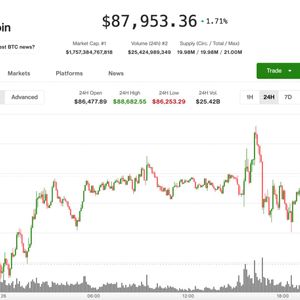
BitcoinWorld Bitcoin Price Defies Logic: Why a Weaker Dollar Fails to Spark Rally in 2025’s Fearful Market In a surprising twist for global markets in early 2025, the Bitcoin price remains stubbornly subdued despite a notable decline in the US Dollar Index (DXY). This counterintuitive dynamic challenges a long-held market axiom and underscores a profound shift in investor psychology, according to a detailed on-chain analysis. Traditionally, cryptocurrency investors have viewed dollar weakness as a direct tailwind for digital assets. However, current conditions reveal a more complex relationship where macroeconomic fear overrides conventional catalysts. Bitcoin Price and the Broken Dollar Correlation The inverse correlation between the US dollar and Bitcoin has formed a cornerstone of crypto market analysis for years. Historically, a falling dollar often signals easier global financial conditions, potentially driving capital toward alternative, non-fiat stores of value. Consequently, analysts frequently cite dollar weakness as a bullish signal for cryptocurrencies. Recent data, however, paints a different picture. The DXY has retreated from recent highs, yet the Bitcoin price continues to trade within a tight, fearful range, lacking upward momentum. This decoupling prompts a critical re-examination of the underlying drivers for crypto asset valuation. GugaOnChain, a noted CryptoQuant contributor and on-chain analyst, provides crucial context for this anomaly. The analyst’s research, reported by CryptoPotato, indicates that a weaker dollar alone is an insufficient catalyst. Instead, it must coincide with specific macroeconomic conditions to fuel a sustainable Bitcoin rally. These conditions primarily include persistent high inflation and abundant systemic liquidity. In such an environment, investors actively seek inflation hedges outside the traditional financial system. Currently, neither condition is fully met, leaving the typical transmission mechanism between dollar value and crypto prices effectively broken. Macroeconomic Fear Drives a Flight to Safety The dominant theme in 2025’s first quarter is a potent risk-off sentiment sweeping across global financial markets. Several factors contribute to this climate of caution. Geopolitical tensions continue to simmer, central banks maintain a restrictive stance compared to the zero-rate era, and concerns about economic growth linger. In this environment, fear governs asset allocation decisions. Investors demonstrate a clear preference for capital preservation over aggressive growth speculation. This psychology directly impacts the Bitcoin price, as the asset’s perceived volatility conflicts with the desire for stability. When fear dominates, capital flows toward assets with centuries of established trust. Gold, the quintessential safe haven, has notably outperformed Bitcoin during recent periods of dollar weakness. This trend highlights a critical distinction in investor perception. Despite being labeled “digital gold” by proponents, Bitcoin has not yet universally achieved that status during systemic stress. The analyst emphasizes that during crises of confidence and extreme risk aversion—scenarios that can also weaken the dollar—cryptocurrencies often decline in tandem with risk assets like stocks. This correlation with equities, rather than decoupling as a true safe haven, currently exerts more influence on the Bitcoin price than dollar movements. The Crucial Role of Liquidity and Inflation To understand the missing link, one must analyze the liquidity landscape. The period of rampant quantitative easing (QE) post-2020 created a massive pool of cheap capital that flowed into various risk assets, including cryptocurrencies. That liquidity tide has receded. Current monetary policy, while not uniformly tight globally, lacks the firehose-like abundance of previous years. Without this excess liquidity sloshing through the system, even a weaker dollar struggles to push significant new capital into the crypto ecosystem. The mechanism is clogged. Similarly, the inflation narrative has evolved. While inflation remains above central bank targets in many economies, the peak fear of hyperinflation or a complete loss of fiat credibility has subsided. This moderation reduces the urgent, panic-driven demand for alternative stores of value. The table below contrasts the historical catalyst environment with current conditions: Macro Factor Historical Rally Catalyst (e.g., 2020-2021) Current Market State (Early 2025) US Dollar Trend Falling Falling Systemic Liquidity Abundant (QE) Restricted / Normalized Inflation Psychology Rising Fear / “Fiat Debasement” Managed Fear / Contained Overall Market Sentiment Risk-On Risk-Off Primary Beneficiary Bitcoin & Risk Assets Gold & Treasuries This comparative analysis clearly shows why the outcome differs despite a similar dollar trend. The surrounding conditions dictate the market’s reaction. Key takeaways for investors include: Context is paramount: Isolated indicators like the DXY provide limited insight. Sentiment dictates flows: Fear overwhelms theoretical correlations. Liquidity is the lifeblood: Without it, price catalysts remain dormant. On-Chain Data and Investor Behavior Beyond macroeconomic theory, on-chain metrics offer a real-time window into investor behavior that explains the stagnant Bitcoin price. Analysis of exchange flows shows neither significant accumulation nor aggressive distribution, indicating a wait-and-see approach. Furthermore, the velocity of Bitcoin—the rate at which it changes hands—remains low. This suggests that existing holders are not transacting actively, and new speculative capital is not entering the network at a scale needed to drive a rally. The market is in a state of equilibrium, biased slightly toward fear. The behavior of long-term holders (LTHs) versus short-term holders (STHs) is particularly telling. LTHs continue to hold steadfast, showing conviction, but they are not providing buying pressure. STHs, typically the source of volatile trading, are inactive or are selling at minimal profits or losses, reflecting the risk-off environment. This stagnation in network activity underscores that a weaker dollar, without accompanying positive sentiment or a compelling macro narrative, fails to trigger the algorithmic and human trading decisions that propel prices upward. Historical Precedents and Market Maturation This is not the first time Bitcoin’s correlation with the dollar has broken down. Similar periods occurred during the 2018 bear market and phases of the 2022 downturn. Each instance coincided with a contraction in global liquidity and a flight to safety. However, the market structure in 2025 is more mature. The presence of institutional players, regulated ETFs, and more sophisticated derivatives means reactions to macro data are more nuanced and less driven by retail speculation alone. This maturation may lead to more frequent periods of decoupling as Bitcoin finds its own equilibrium based on a broader set of factors, including: Adoption metrics and network utility Regulatory developments Institutional custody flows Global accessibility and legal tender status in select nations Conclusion The analysis reveals a critical lesson for 2025: the Bitcoin price does not move in a vacuum based on a single inverse indicator like the US dollar. Its trajectory is a complex function of liquidity, macroeconomic sentiment, and competing safe-haven assets. The current risk-off climate, characterized by fear and a preference for traditional stores of value like gold, has severed the simple weak-dollar-strong-Bitcoin narrative. For a sustained rally to materialize, the market likely requires a shift back to a risk-on mindset, coupled with renewed liquidity or a sharp resurgence in inflation fears. Until then, dollar weakness alone will remain an insufficient catalyst, highlighting the cryptocurrency market’s ongoing integration into and reaction to broader global financial dynamics. FAQs Q1: Why isn’t Bitcoin rising if the US dollar is getting weaker? A1: A weaker dollar typically helps Bitcoin only when combined with high inflation and abundant market liquidity. Currently, widespread risk-off sentiment and fear are driving investors toward traditional safe havens like gold instead, overriding the dollar’s influence. Q2: What does “risk-off sentiment” mean for cryptocurrency? A2: Risk-off sentiment describes a market environment where investors prioritize safety and capital preservation. They sell volatile assets like stocks and cryptocurrencies and move money into perceived stable assets such as government bonds, gold, and stable currencies, leading to downward pressure on the Bitcoin price. Q3: Has the correlation between Bitcoin and the US dollar changed permanently? A3: Not necessarily. Correlations in financial markets are dynamic. The relationship may reassert itself if macroeconomic conditions shift back to a high-liquidity, risk-on environment. The current decoupling shows Bitcoin’s price drivers are multifaceted and context-dependent. Q4: What macroeconomic conditions would help Bitcoin rise alongside a weaker dollar? A4: Key conditions include aggressive monetary easing (creating new liquidity), a sharp rise in inflation expectations that undermines faith in fiat currency, and a general shift in investor psychology from fear to optimism about economic growth and risk assets. Q5: How does gold’s performance relate to Bitcoin’s current price action? A5: Gold’s outperformance during this period of dollar weakness acts as a clear signal of the market’s risk-off preference. Capital is flowing into the established, centuries-old store of value rather than the newer digital alternative, demonstrating that in times of acute fear, perceived stability trumps technological innovation for many investors. This post Bitcoin Price Defies Logic: Why a Weaker Dollar Fails to Spark Rally in 2025’s Fearful Market first appeared on BitcoinWorld .